0.76
State recovery
On matched multiplayer Snake, MASS reaches 0.76 state recovery. The strongest video-based baseline reaches 0.128.
Alaya Lab research
One shared world, rendered from any view.
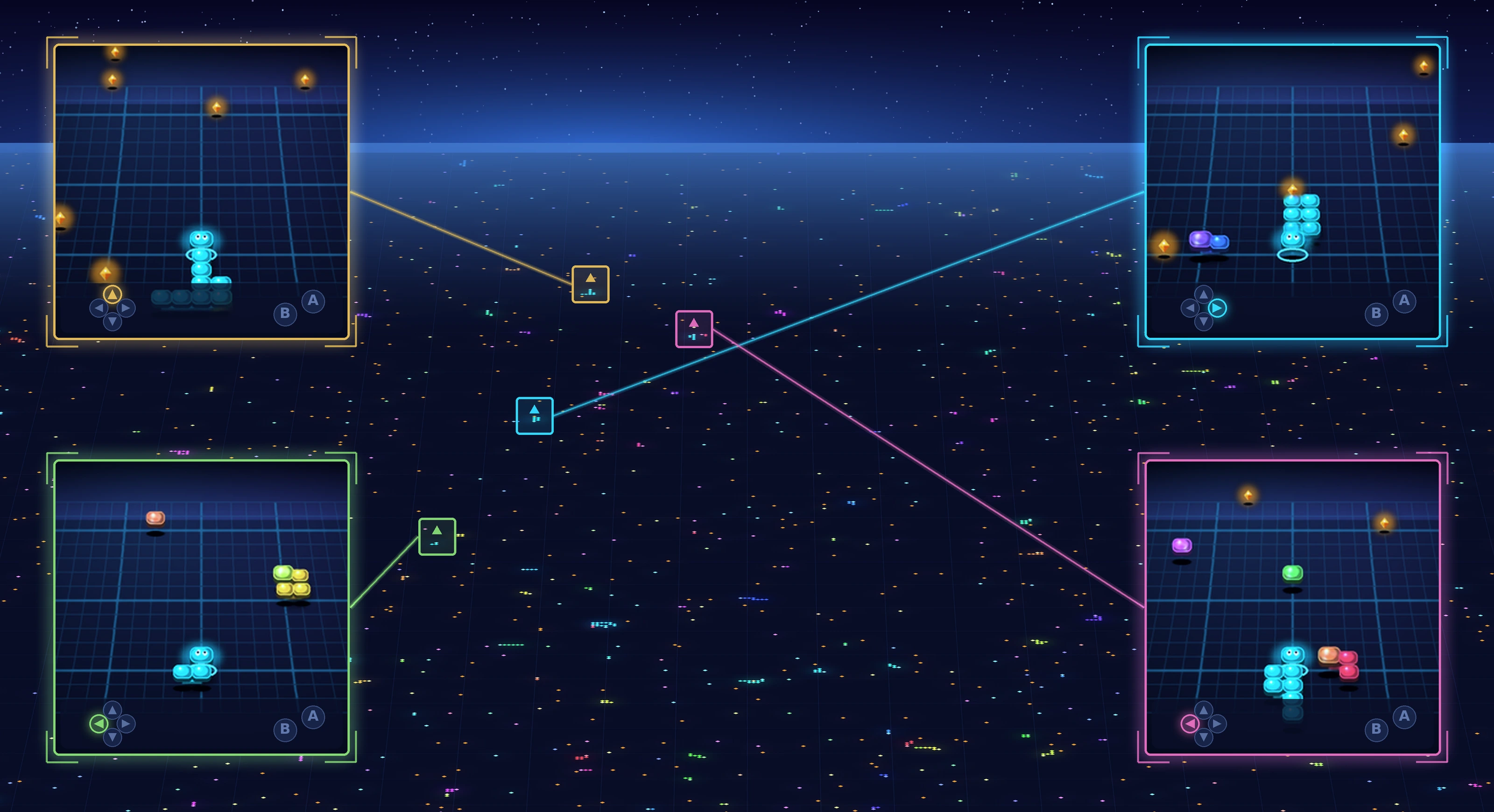
MASS is a multiplayer world model that advances one authoritative typed state, then synthesizes any requested client view from that shared prediction.
01 / Why MASS
Visual world models often use each observed view as recurrent memory. In multiplayer settings, that means maintaining separate visual histories for the same world, and those histories can drift apart across cameras.
MASS separates world dynamics from view synthesis. Its Logic Engine predicts the complete typed state from joint actions. The Rendering Engine uses that state and a client camera to generate the requested observation.
Every client shares the same synchronization reference. The simulation cost stays fixed as more views are requested.
02 / System
Select a stage to see what information it receives and produces.
03 / Across worlds
MASS produces state-conditioned renders for Snake, Crate Pusher, Pac-Man, Tank Battle, Lunar Touchdown, Frogger, Tron, and Bomberman. Each column shows a different game, and each row shows a different predicted state.
Each game uses the same Logic Engine and Rendering Engine architecture with its own schema and weights.
04 / Evidence
0.76
On matched multiplayer Snake, MASS reaches 0.76 state recovery. The strongest video-based baseline reaches 0.128.
1,024
MASS advances 1,024 players together in one predicted world backed by a single authoritative state.
10,000
The long-horizon test runs the recurrent model for 10,000 ticks. It is separate from the matched-accuracy benchmark.
Matched visual evidence
Drag the divider to compare MASS with a retrained official MultiWorld baseline. Both images use the same viewpoint and action sequence. In this example, MASS stays closer to the canonical scene structure while MultiWorld drifts.
This is one representative qualitative episode, not a test-set average.
 MultiWorld
 MASS
MASS
05 / Results
The first test branches one predicted world with three action streams. The second follows a recurrent rollout for 10,000 ticks.
MASS runs the recorded joint-action stream, its reverse, and a constant action from the same Crate Pusher state. The crate positions differ by tick 64.
The left grid shows client views; the right panel compares crate positions at tick 64.The test tracks Crate Pusher snapshots, entity counts, and single-GPU Logic Engine latency.
This execution-scale test is separate from matched rollout accuracy.Publication
MASS predicts the shared game state before rendering any player view. That state carries the rollout forward and keeps clients synchronized. Each camera is rendered from it only when needed.
AuthorsZiqi Cai, Siqi Yang, Yimu Wang, Zixian Gao, Yunheng Liu, Shuchen Weng, Erwin Wu, Kaipeng Zhang, Boxin Shi
AffiliationsAlaya Lab · Peking University · Institute of Science Tokyo
ProjectWorld models · multiplayer simulation · learned rendering