A
Scene-aware navigation
A vision-language backbone reads the previously generated panorama and turns each instruction into an explicit displacement or a localized goal.
 SPW-Nav
arXiv 2610.089412026Above: 360° panoramas generated by SPW-Nav, unrolled
A Streaming Panoramic World Model
for Language-Guided Navigation
1Alaya Lab2Peking University3Institute of Science Tokyo
* Equal Contribution‡ Project Leader† Corresponding Authors
01Overview
Tell it where to go. SPW-Nav reads each instruction in the panorama it has just generated, and keeps streaming the world in every direction as the route changes.
Both streams share the same history. At the same moment, a different instruction sends each stream toward a different landmark. Drag the view to look around.
02Abstract
Language-guided panoramic video generation benefits various downstream applications, such as interactive 3D scene exploration, virtual reality experiences, and embodied agent training. Existing panoramic generators follow predefined trajectories, and interactive world models act through low-level actions in perspective views. We propose SPW-Nav, a streaming panoramic world model that understands movement instructions and streams one minute of 2K 360° video in real time from a single panorama. SPW-Nav interprets each instruction in the previously generated panorama as camera motion. Spherical rotation decoupling applies rotation exactly on the sphere, pose-aligned conditioning keeps translation inputs bounded over long streams, and a multi-term memory with a few-step generator continues the scene as instructions change. We also build SPW-NavSet, panoramic videos with camera trajectories and verified instructions. Driven by language, SPW-Nav outperforms prior panoramic generators in camera-following accuracy and video quality, and supports on-the-fly instruction switching.
03Method
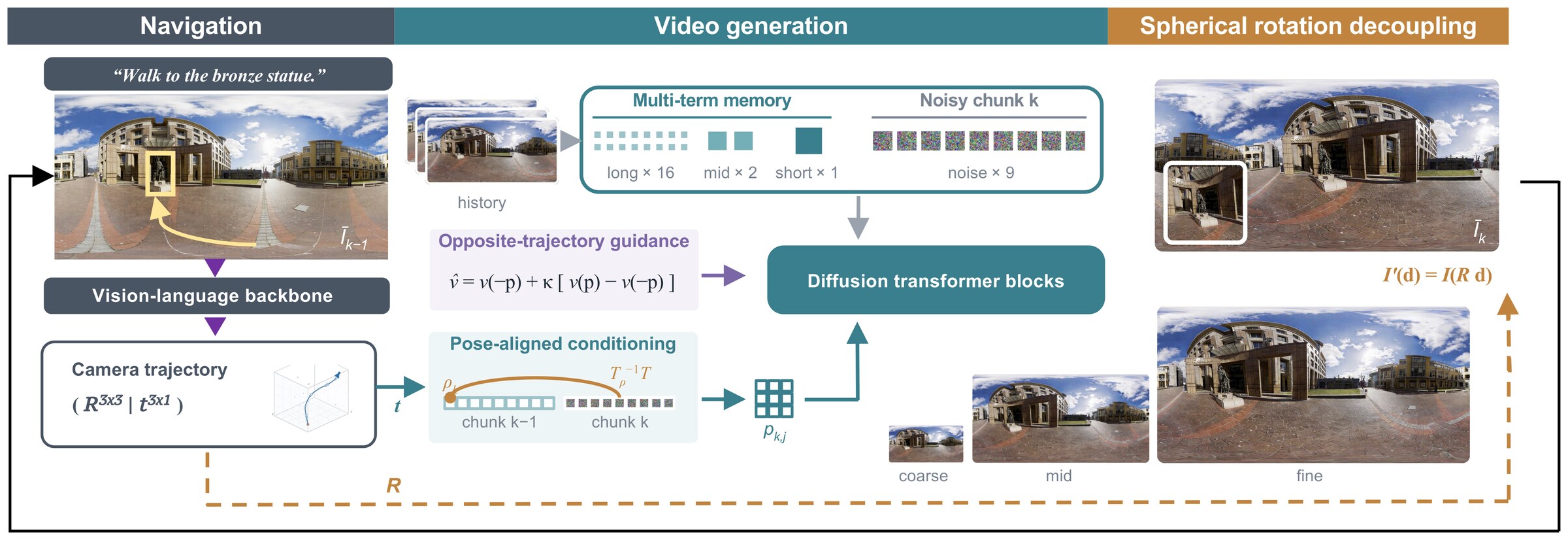
A vision-language backbone turns each instruction into a camera trajectory in the latest panorama. The video backbone generates the translation of each chunk from a multi-term memory, and the rotation is applied afterwards by resampling the sphere.
A
A vision-language backbone reads the previously generated panorama and turns each instruction into an explicit displacement or a localized goal.
B
Spherical rotation decoupling applies the commanded rotation exactly by resampling the sphere, leaving only translation to the video backbone. Pose-aligned conditioning expresses this translation relative to the previous chunk and keeps the pose inputs bounded however long the navigation runs.
C
Noise-tail trajectory learning focuses training and distillation on high noise levels, and opposite-trajectory guidance contrasts the commanded translation with its reverse. A distilled pyramid generator with sparse attention and a multi-term memory sustain one-minute streams.
04Instruction switching
Consecutive instructions in one stream. Each instruction is read in the last generated panorama, and the memory holds only generated frames.
05Long streams
Continuous streams generated from a single panorama outside the training data. Select any video to look around in 360°.
06Camera control
All methods receive the same first panorama and follow the same ground-truth trajectory, each through its own interface. Videos play in sync.
Trajectory
07Closed routes
Each route ends at its starting pose, so the last frame should show the same view as the first. Videos play in sync.
Route
08Citation
@article{liu2026spwnav,
  title   = {SPW-Nav: A Streaming Panoramic World Model for Language-Guided Navigation},
  author  = {Liu, Yunheng and Cai, Ziqi and Yang, Siqi and Wang, Yimu and Teng, Minggui and
             Tan, Jiaming and Weng, Shuchen and Wu, Erwin and Zhang, Kaipeng and Shi, Boxin},
  journal = {arXiv preprint arXiv:2610.08941},
  year    = {2026}
}