
Resume the world.
Restore rule definitions, dependencies, and object states together—not just the last image.
RULE-GOVERNED GENERATIVE WORLDS
Interactive World Modeling under Configurable Rules
01 / THE IDEA
Change what an action means. Keep what the world remembers.
A switch can open a door before it comes into view. A defeated monster can leave a key that is still there after you return. Generative worlds need to preserve the logic behind these interactions—and make its consequences visible.
WorldRuler connects rule execution, video generation, and perceptual feedback through an executable 3D rule graph.

Restore rule definitions, dependencies, and object states together—not just the last image.
Bind rule entities to visual instances, including objects that appear only later.
Guide designated attributes while preserving compatible appearance, motion, and unrelated content.
02 / THE METHOD
A persistent rule graph and a visual generation loop connect symbolic state to what you see.

Rules, dependencies, object identities, attributes, and spatial information live in a shared representation.
Stored rule targets constrain newly visible objects from their first appearance, with feedback refining correspondences.
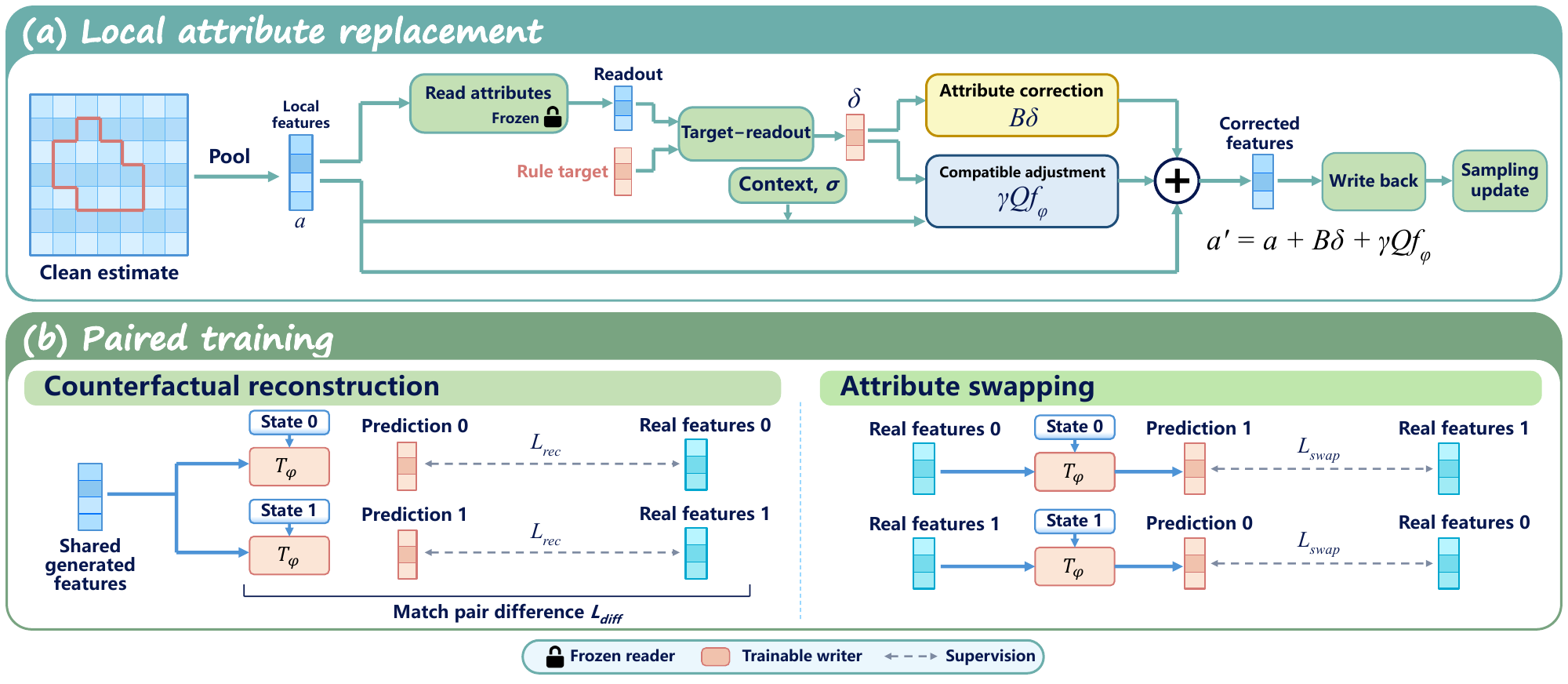
A frozen reader estimates object attributes. A trained writer applies rule-directed corrections during generation.
Counterfactual reconstruction and bidirectional attribute swapping train the replacement operator using paired videos. The video generator and attribute reader remain frozen.
03 / IN THE WORLD
Compare GTA-V and Habitat videos with rules disabled and enabled.
04 / A RULE CHAIN, VISUALIZED
A temple walkthrough combines generated footage, reconstructed 3D geometry, and synchronized rule annotations.
Defeat goblin → Key appears
Collect key → Carry key
Use key → Open gate
05 / THE DATASET
One world. Two possible outcomes.
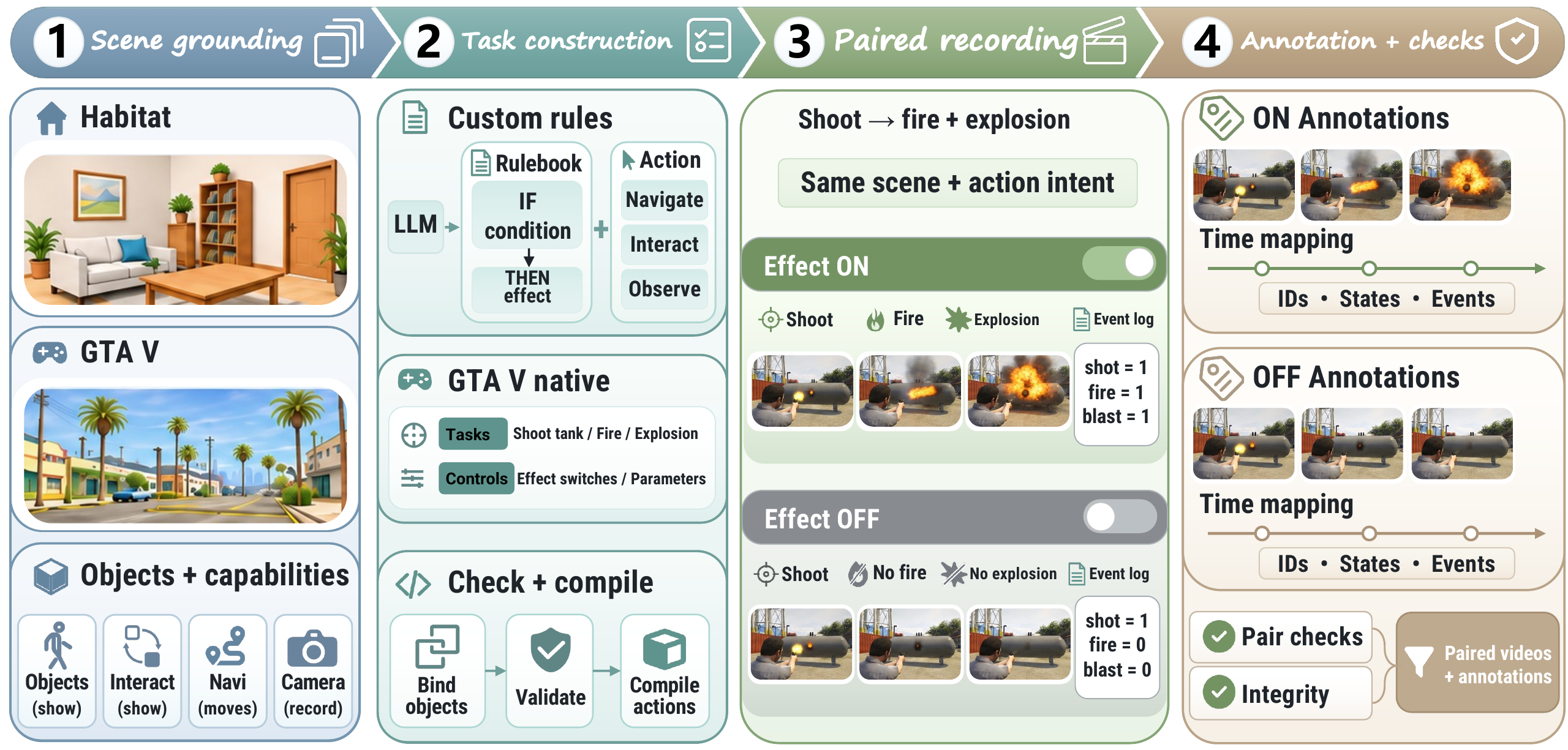
Paired rule-driven interactions. Collected in Habitat and GTA-V.
Each pair shares the scene configuration and action intent, while a designated rule mechanism is enabled or disabled. The resulting videos capture different state evolutions, with annotations of states, events, and rule outcomes.
Scene-aware splits separate training and test groups. The collection pipeline covers object attributes, spatial relationships, and effects that begin outside the current view.
| Trigger / effect | Attribute | Geometry | Presence | Topology |
|---|---|---|---|---|
| Action | 7.3 | 7.8 | 4.9 | 4.5 |
| Spatial | 5.2 | 5.6 | 2.2 | 3.7 |
| Relation | 5.6 | 5.4 | 3.6 | 2.6 |
| State | 6.6 | 7.1 | 5.0 | 3.4 |
| Sequence | 5.9 | 5.9 | 3.7 | 3.9 |
| Trigger / effect | Attribute | Geometry | Presence | Behavior |
|---|---|---|---|---|
| Action | 15.3 | 10.9 | 2.9 | 12.7 |
| Spatial | 5.6 | 4.2 | 1.5 | 5.6 |
| Relation | 2.7 | 2.0 | 0.7 | 2.5 |
| State | 5.9 | 3.6 | 1.4 | 5.6 |
| Sequence | 5.6 | 4.3 | 1.3 | 5.7 |
| Binding | Habitat | GTA-V |
|---|---|---|
| Single-object | 18.5 | 41.1 |
| Cross-object | 60.2 | 40.2 |
| Environment | 21.3 | 18.7 |
| Environment | Median activation |
|---|---|
| Habitat | 65.5 |
| GTA-V | 55.5 |
@article{zhai2026worldruler,
  title={WorldRuler: Interactive World Modeling under Configurable Rules},
  author={Mingliang Zhai and Chuanhao Li and Jiaming Tan and Zhen Li and Yuwei Wu and Yunde Jia and Zian Meng and Yuanyang Yin and Kaipeng Zhang},
  journal={arXiv preprint arXiv:2611.24869},
  year={2026}
}